Website Preview
Tool Guide
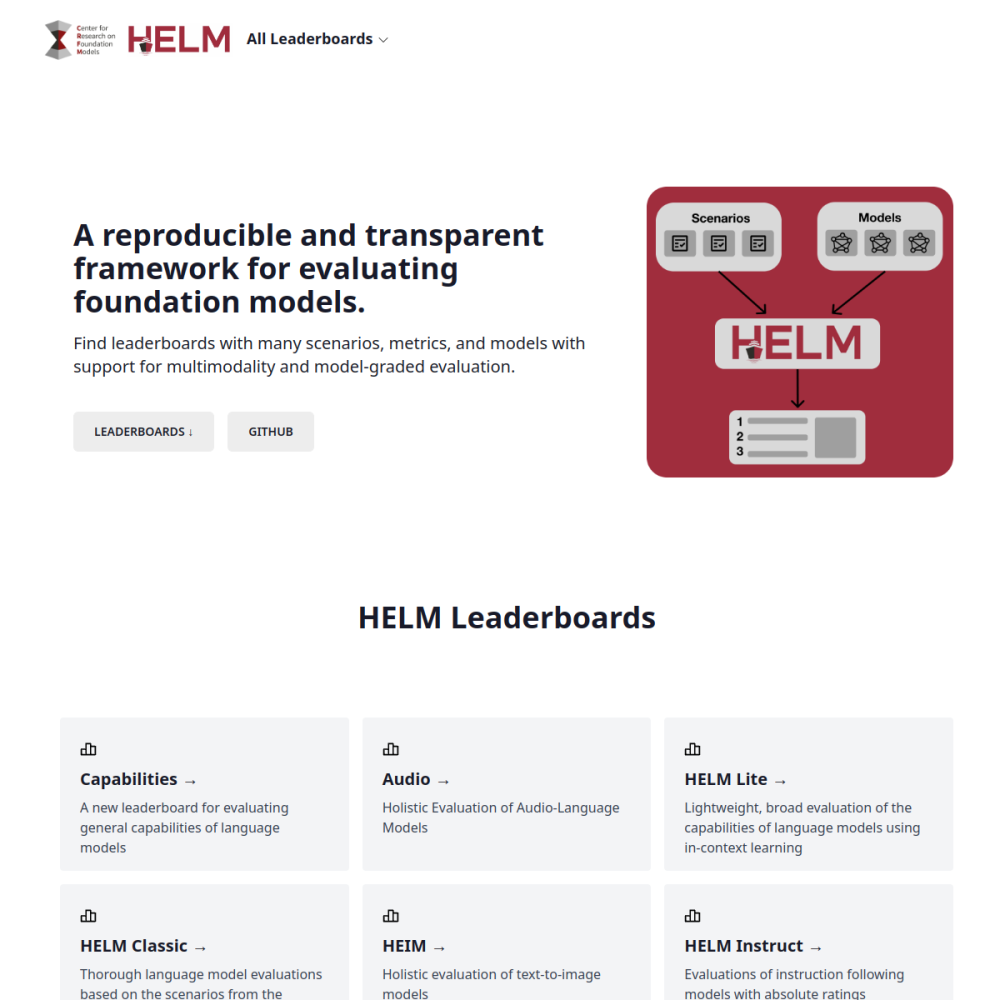
HELM represents a significant resource in the field of artificial intelligence benchmarks. Developed by Stanford, this framework offers a holistic approach to evaluating large language models. Instead of relying on isolated metrics, it aims to provide a comprehensive view of model capabilities and limitations.
For teams navigating the complex landscape of AI tools, HELM provides structured data to support informed decisions. By aggregating evaluation results, the platform helps users understand how different models perform across various tasks and scenarios. This transparency is essential for building reliable AI systems.
HELM is a benchmarking framework designed to assess large language models systematically. It was created by Stanford to address the need for consistent and comprehensive evaluation methods. The tool moves beyond simple accuracy scores to consider broader performance aspects.
The framework serves as a central repository for evaluation data. It allows users to compare different models against standardized criteria. This standardization helps reduce confusion in the rapidly evolving AI market.
The primary feature of HELM is its holistic evaluation methodology. It examines models across multiple dimensions rather than focusing on a single task. This approach reveals strengths and weaknesses that might be hidden in narrower tests.
The platform is maintained by Stanford to ensure the evaluation standards remain rigorous. Users can access detailed reports and data through the official website. This academic backing adds credibility to the findings.
HELM is designed for AI researchers seeking robust evaluation data. It supports developers who need to select the right model for specific applications. Organizations looking to deploy AI responsibly will also find value in this tool.
The framework is particularly useful for those who require transparency in model performance. It caters to technical users who understand the nuances of LLM capabilities. Academic institutions and industry teams alike can utilize the data for comparative analysis.
One common use case is comparing multiple models before deployment. Teams can use HELM data to identify which model fits their specific requirements best. This reduces the risk of choosing an underperforming solution.
Researchers also use HELM to study model behavior across different tasks. It helps in identifying areas where current technology falls short. This insight drives future development and improvement in the field.
To begin using HELM, visit the official Stanford website. Explore the available dashboards and documentation provided by the developers. Familiarize yourself with the evaluation categories offered.
Users should review the methodology to understand how scores are calculated. Applying this knowledge ensures accurate interpretation of the results. Start with broad comparisons before drilling down into specific metrics.
HELM is designed to provide holistic evaluation of large language models through standardized benchmarks.
The framework was developed by Stanford, specifically associated with their Center for Research on Foundation Models.
Users can access the tool and its data through the official website at crfm.stanford.edu/helm.