Website Preview
Tool Guide
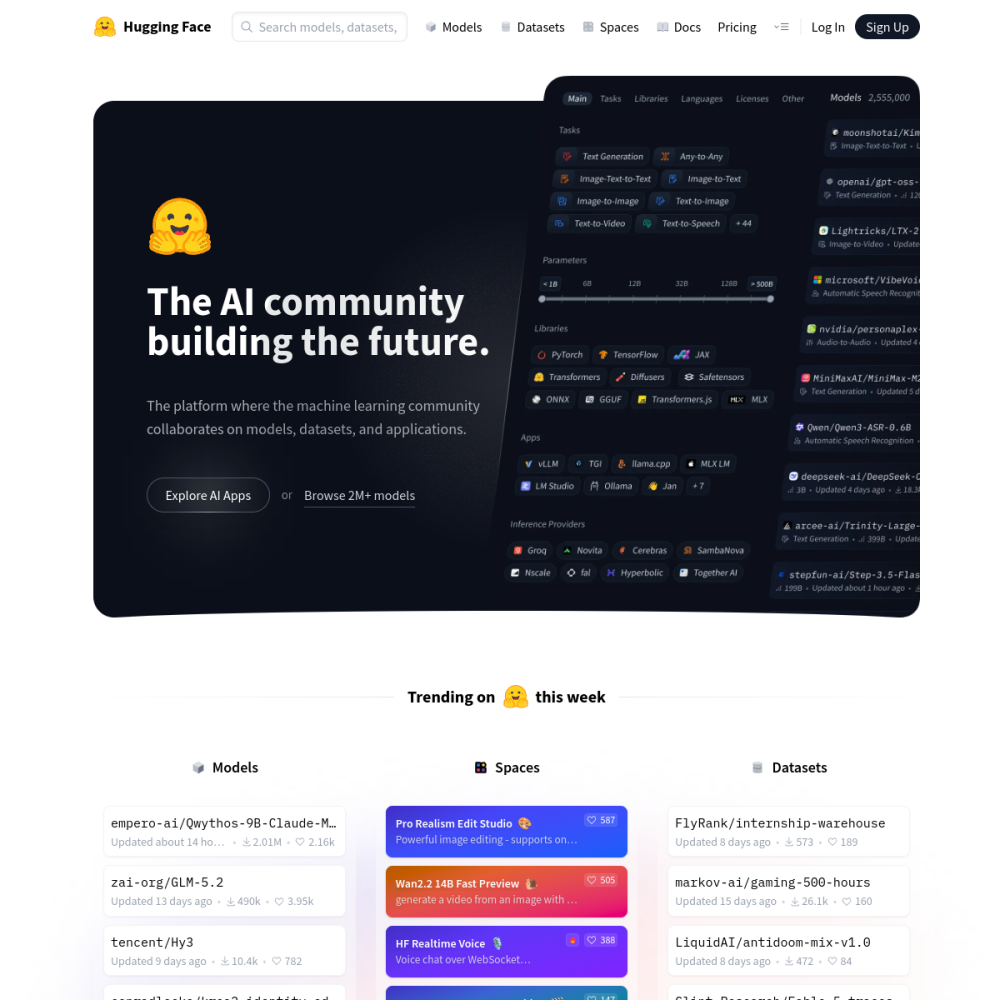
Hugging Face serves as the largest AI model and dataset hub available online. It functions as a central repository where developers can find, share, and collaborate on machine learning projects. The platform hosts a vast collection of pre-trained models across various tasks, making it a go-to resource for the AI community.
Beyond simple storage, the ecosystem encourages open collaboration. Users can access tools designed to streamline the machine learning workflow, from data preprocessing to model deployment. This structure supports both individual experimentation and large-scale organizational needs within the artificial intelligence sector.
Hugging Face is a community-driven platform focused on natural language processing and machine learning. It operates similarly to GitHub but specializes in AI models, datasets, and demo applications. The site allows users to upload their own work or download existing solutions for immediate use.
The platform supports multiple frameworks and programming languages, ensuring broad compatibility. By centralizing these resources, it reduces the barrier to entry for implementing advanced AI capabilities. Researchers and engineers rely on this infrastructure to track versions and manage dependencies effectively.
The primary feature is the extensive library of pre-trained models. These models cover tasks such as text generation, translation, and image classification. Users can search for specific capabilities and integrate them directly into their applications using standardized APIs.
Another critical component is the dataset repository. High-quality data is essential for training effective models, and this hub provides curated collections for various industries. Additionally, the platform offers Spaces, which allow users to host and share interactive machine learning demos without complex server management.
This tool is designed for machine learning engineers, data scientists, and AI researchers. Professionals in these fields use the platform to accelerate development cycles by leveraging existing work. It removes the need to train models from scratch for common tasks.
Students and hobbyists also benefit from the open-source nature of the content. Educational institutions often recommend these resources for learning modern AI techniques. Organizations seeking to deploy custom AI solutions find the collaboration tools useful for team management and version control.
Developers frequently use the platform to find Large Language Models for chatbots and content generation. These LLMs can be fine-tuned on specific data to match organizational tone and requirements. The availability of diverse architectures allows for testing different approaches before committing to a solution.
Data scientists utilize the dataset hub to source training material for computer vision or audio processing projects. Researchers publish their findings here to gain feedback and citations from the global community. Companies also use the hosting features to demonstrate proof-of-concept applications to stakeholders.
To begin, users should create an account on the official website. Browsing the model library allows you to understand the available options and licensing terms. It is advisable to start with popular models to ensure stability and community support before exploring niche architectures.
When integrating models, review the documentation for specific installation requirements. Many models require specific hardware configurations to run efficiently. Engaging with the community forums can provide troubleshooting advice and best practices for deployment scenarios.
Many models and datasets are open-source and free, though some may have specific licensing terms or require paid compute resources for deployment.
Yes, users can upload their own trained models and datasets to share with the community or keep private for internal team use.
Yes, the platform hosts a wide variety of LLMs and provides tools specifically designed for managing and deploying these large-scale architectures.