Website Preview
Tool Guide
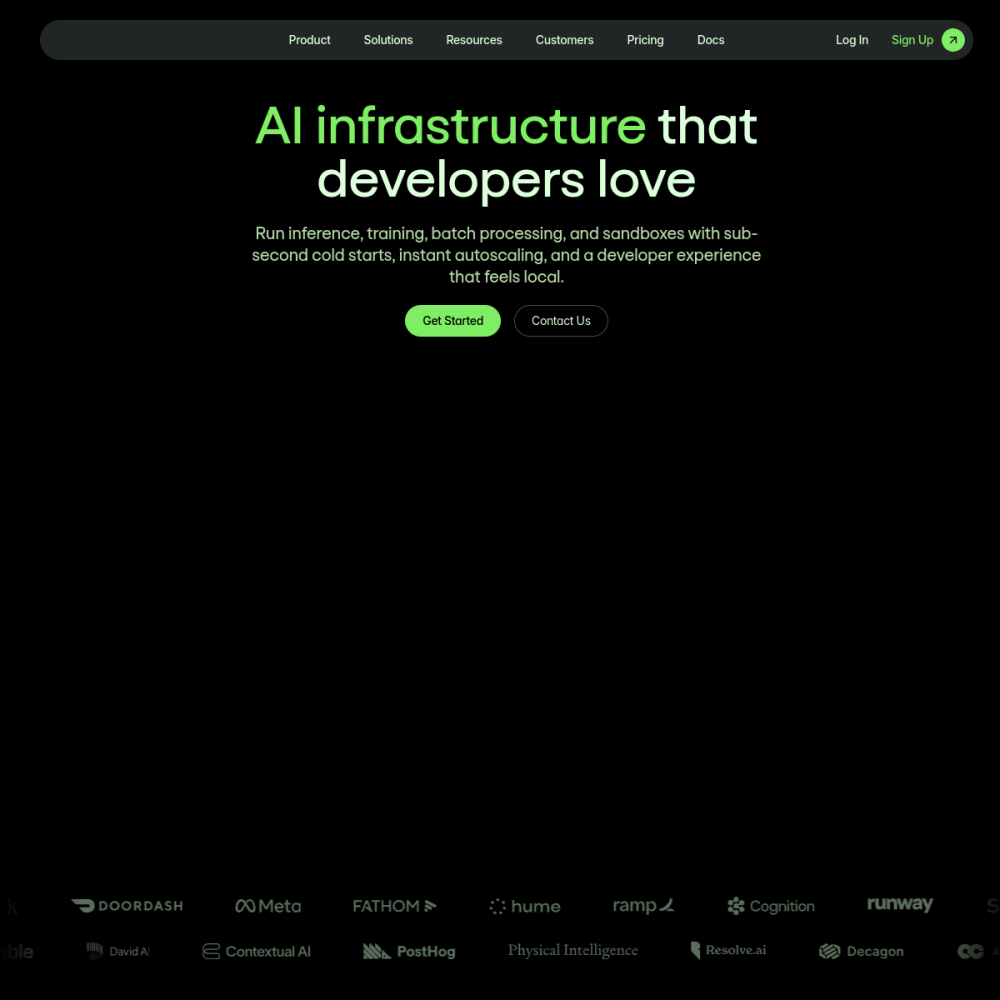
Modal operates as a serverless cloud infrastructure specifically built for artificial intelligence workloads. It allows developers to train and deploy models without managing underlying hardware or server configurations. This approach reduces the complexity typically associated with cloud machine learning operations.
This platform focuses on simplifying the machine learning lifecycle. By handling infrastructure scaling automatically, users can concentrate on building model logic rather than maintaining cloud resources. It streamlines the path from experimentation to production.
Modal defines itself as a serverless cloud for AI train & deploy. It functions as a compute layer where users run code without provisioning servers manually. The system abstracts away infrastructure management tasks completely.
This means developers write standard Python code while the platform handles resource allocation and scaling based on demand. It bridges the gap between local development and production deployment for machine learning projects effectively.
The platform removes the need for traditional server maintenance. Users submit workloads, and the infrastructure adapts to the compute requirements automatically.
The primary feature is serverless execution. Users submit functions or containers, and the platform executes them instantly without idle costs. It supports GPU access for training heavy models.
This ensures that compute-intensive tasks have the necessary hardware resources available on demand. Integration with standard development workflows is a core component.
Developers can use familiar tools and libraries within the Modal environment without significant friction. The system handles scaling and resource allocation behind the scenes.
This tool is designed for AI developers and data scientists. They benefit from reduced operational overhead when moving models from experimentation to production. Startups and engineering teams also use Modal.
These groups often lack dedicated DevOps staff to manage complex cloud infrastructure for machine learning pipelines. Any organization needing scalable compute for AI workloads without long-term hardware commitments can utilize this platform for their needs.
It is particularly useful for teams that prioritize speed and flexibility over managing physical server clusters.
Training machine learning models is a primary use case. Users can spin up GPU resources for training jobs and release them once the process completes. Deploying inference endpoints is another common application.
Modal allows models to serve predictions via API without maintaining always-on servers. Running batch processing jobs for data preparation also fits within this infrastructure.
It handles variable workloads efficiently while maintaining performance standards. This makes it suitable for projects with fluctuating compute requirements.
To begin, users typically install the Modal SDK and authenticate with their account. This setup enables local code to run on the cloud infrastructure seamlessly. Developers should structure their code into functions or classes compatible with the platform.
Keeping dependencies clear ensures smooth deployment processes. Monitoring resource usage is recommended. Since it is serverless, understanding how compute scales helps optimize costs for larger projects significantly.
Testing locally before pushing to the cloud can help identify issues early in the development cycle.
Modal is used for training and deploying AI models on a serverless cloud infrastructure. It eliminates the need for manual server provisioning.
No, Modal handles server management automatically. This allows users to focus entirely on their code and model logic instead of infrastructure maintenance.
Yes, the platform supports GPU access for training and inference tasks requiring high compute power. Users can access these resources on demand.